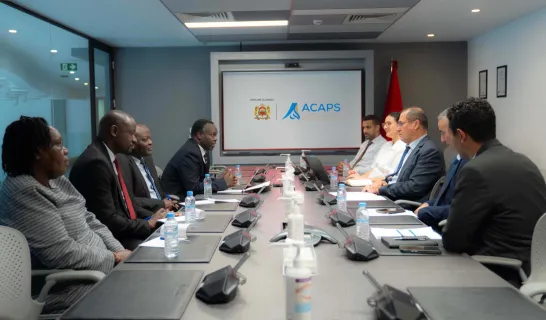
Twenty-third meeting of the Coordination and Systemic Risk Monitoring Committee
07/07/2026

The Coordination and Systemic Risk Monitoring Committee (CCSRS), chaired by the Governor of Bank Al-Maghrib and composed of representatives from the Moroccan Capital Market Authority (AMMC), including its Chairperson; the Supervisory Authority of Insurance and Social Welfare (ACAPS), including its Chairperson, and the Ministry of Economy and Finance (MEF), including the Director of the Treasury and External Finance, held its twenty-third meeting on Tuesday, July 7, 2026, at Bank Al-Maghrib’s headquarters in Rabat.
The Committee reviewed and approved the thirteenth edition of the Financial Stability Report for the year 2025. It also reviewed the state of progress of the 2026–2030 financial stability roadmap, analyzed the mapping of systemic risks, reviewed the findings of the work of its monthly sub-committee, and examined the situation of the financial system in light of observed and expected macroeconomic and financial developments.
Based on the monitoring indicators reviewed, the Committee noted that the Moroccan financial system continues to demonstrate resilience, underpinned by solid fundamentals and, overall, comfortable prudential margins.
The Committee noted the following:
- The global economy displayed a certain resilience in 2025 thanks to the momentum of domestic demand and the accommodative stance of monetary policies, but the intensification of macro-financial vulnerabilities, fueled in particular by geopolitical tensions and the high level of indebtedness, continues to weaken its outlook. Against this backdrop, the growth of national economy improved notably, driven by favorable weather conditions and the strength of many non-agricultural activities. It rose from 4.4 percent in 2024 to 4.9 percent in 2025 and, according to Bank Al-Maghrib’s projections, is expected to accelerate to 5.2 percent in 2026 before slowing to 3.1 percent in 2027, under the assumption of an average cereal crop year. Inflation, for its part, remained low, standing at 0.8 percent in 2025 after 0.9 percent a year earlier, and is expected to settle at 1.5 percent in 2026 and then at 2.1 percent in 2027.
On the external accounts front, the current account deficit stood at 2.4 percent of GDP in 2025 and is expected to widen to 4 percent in 2026 before narrowing to 3.8 percent in 2027. Taking into account transactions in the financial account, official reserve assets would continue to strengthen to ensure, by 2027, the equivalent of 6 months and 9 days of imports of goods and services. - With regard to public finances, fiscal consolidation continues. The deficit, excluding proceeds from the sale of government equity holdings, narrowed to 3.5 percent of GDP in 2025 and is expected to settle at 3.4 percent in 2026 and 2027. Under these conditions, the Treasury debt ratio is expected to pursue its gradual decline over the medium term to stand at 65.1 percent of GDP in 2027.
- As regards bank credit, loans to the non-financial sector rose by 6.5 percent in 2025, driven by the good momentum in non-agricultural activities and the easing of monetary conditions. The non-performing loan rate, for its part, declined slightly to 8.3 percent at the end of 2025, down from 8.4 percent a year earlier, and its provision coverage rate remained at around 68 percent.
- In this context, the banking sector pursued, for the third consecutive year, the consolidation of its financial performance. As of the end of December 2025, the aggregate net income on a corporate basis stood at 19.2 billion dirhams, up 22.2 percent compared to the previous year, driven in particular by the increase in net banking income and the decrease in the cost of credit risk. This performance reinforces the solidity of credit institutions, with the average solvency ratio standing at 16.1 percent and the Tier 1 capital ratio at 13.5 percent —levels well above regulatory requirements. Furthermore, macro-stress testing exercises continue to confirm the resilience of the main banks in the face of severe shock scenarios. The short-term liquidity ratio also remains above the regulatory minimum.
- Concerning Financial Market Infrastructures, the results of the monitoring and assessments carried out continue to confirm their strong resilience, both financially and operationally, and show that they still present a low level of risk to financial stability.
- For its part, the insurance sector pursued its growth momentum amid a generally favorable economic environment. At the end of 2025, the sector’s turnover reached 63.2 billion dirhams, up 7.5 percent, driven by both the life branch (8.4 percent) and the non-life branch (6.6 percent). The life branch, in particular, confirmed the renewed momentum initiated the previous year, supported by the good performance of the savings activity, whose collection rose by 8.9 percent.
- In terms of profitability, the sector posted net income of 5.3 billion dirhams, up 21.4 percent, supported mainly by strong financial results. This positive trend enabled the return on equity (ROE) to reach 11.1 percent, its highest level over the past ten years.
- In the wake of the financial market’s strong performance, unrealized capital gains rose sharply to 62.5 billion dirhams. The ratio of unrealized gains on investments thus stood at 23.8 percent, also a historic high, driven mainly by rising stock market valuations against a backdrop of two consecutive years of strong growth in the MASI index.
- The marked improvement in unrealized capital gains and profitability enabled to reinforce the components of the sector’s solvency margin, whose regulatory ratio rose by 54.7 points to reach 409.4 percent. Furthermore, stress testing exercises bring out an overall resilience of insurance companies to adverse macroeconomic and technical conditions.
- With regard to the pension sector, the application of the second and final tranche of salary increases resulting from the social dialogue of April 29, 2024, enabled the improvement of certain financial indicators of public sector schemes. These schemes, however, continue to show structural imbalances, and their long-term viability has not experienced any significant improvement. In this context, the systemic reform of the sector, based on the setting up of two poles (public and private), remains essential in order to absorb a large portion of uncovered liabilities and ensure the long-term financial sustainability of the schemes.
- On the Casablanca Stock Exchange, after the strong growth recorded in 2025, the market evolved within a context of consolidation during the first half of 2026. As of June 30, 2026, the MASI index stood at 18,217.27 points, down 3.34 percent over the half-year, while
market capitalization remained virtually stable at 1,043 billion dirhams (compared to
1,040.69 billion dirhams at the end of 2025). The average volatility level increased from 14.63 percent during 2025 to 21.5 percent in the first half of 2026, while the liquidity ratio stood at 12.25 percent at the end of May 2026, against 14.23 percent at the end of December 2025. - In the bond market, activity remained sustained during the first five months of 2026. Issuances of Treasury notes amounted to 58.18 billion dirhams at the end of May 2026, at a level comparable to that recorded a year earlier (57.5 billion dirhams at the end of May 2025). In the private debt market, issuances reached 41 billion dirhams at the end of May 2026, including 32.7 billion dirhams of negotiable debt securities and 8.3 billion dirhams of bonds. This momentum reflects the significant contribution of the capital market to the diversification of funding sources for the economy.
- The collective investment industry pursues its development. As of June 19, 2026, the total net assets of UCITS stood at 832.85 billion dirhams, up 6.1 percent on an annual basis. Net subscriptions reached 51.7 billion dirhams, mainly directed toward short-term bond UCITS (51 percent), money-market UCITS (33 percent), and diversified UCITS (19 percent), while medium-and long-term bond UCITS recorded net redemptions (-11 percent). Other categories of collective investment undertakings also pursued their development, with the net assets of real estate investment funds (OPCI) standing at 140.71 billion dirhams at the end of March 2026, while the outstanding amounts of private equity investment schemes (OPCC) and securitization funds (FPCT) reached 6.09 billion and 32.32 billion dirhams, respectively.
- With regard to the investor base, the interest of individual investors for the capital market continued to strengthen. The number of securities accounts reached 434,515 as of March 31, 2026, up 8.3 percent compared to the end of December 2025. The number of UCITS unit holders stood at 34,326 as of June 19, 2026, 74 percent of whom are resident individual investors. These developments reflect the gradual broadening of the investor base and the increasing depth of the capital market.
Finally, the Committee took note of the progress made in the fight against money laundering and terrorist financing. While welcoming the progress accomplished, it emphasized the need to continue efforts to consolidate these gains, maintain a high level of compliance with international standards, and prepare for the next cycle of MENAFATF mutual evaluations.
On the sidelines of this meeting, Bank Al-Maghrib, the Moroccan Capital Market Authority (AMMC) and the Supervisory Authority of Insurance and Social Welfare (ACAPS) proceeded to the signing of a new data exchange agreement, updating the one established between the three authorities in 2014. This agreement strengthens the modalities for sharing the information necessary for the exercise of their missions of preserving financial stability