Twenty-Second Meeting of the Coordination and Systemic Risk Monitoring Committee
23/12/2025
The Coordination and Systemic Risk Monitoring Committee (CCSRS) held its twenty-second meeting on Tuesday, December 23, at Bank Al-Maghrib headquarters in Rabat.
After establishing the final assessment of the previous financial stability roadmap, the Committee reviewed and approved the new one, which aims to consolidate the achievements and strengthen the national financial stability framework. It revolves around five key pillars: strengthening the institutional and legal framework; deepening the analytical framework; developing macroprudential instruments; reinforcing the resolution and crisis management framework; as well as enhancing financial stability–related communication.
The Committee then reviewed the systemic risk map and examined the outcomes of the work conducted by its monthly sub-committee, which provides a holistic analysis of the financial system’s situation as well as identified and expected macroeconomic trends. In this regard, the Committee noted the following:
- Although the global economy showed relative resilience during the first half of 2025, supported by the temporary trade frontloading, it is expected to continue slowing in 2026, with an improvement only materializing in 2027. The outlook remains surrounded by significant uncertainties, particularly related to the evolution and implications of U.S. tariff policy and the persistence of geopolitical tensions. Despite this less favorable international environment, domestic economic growth is expected, according to Bank Al-Maghrib projections, to significantly accelerate from 3.8 percent in 2024 to 5 percent in 2025, and to consolidate at an average of 4.5 percent over the 2026–2027 horizon, driven by the investment’s momentum. With regard to inflation, after averaging 0.8 percent over the first eleven months of 2025, it is expected to accelerate to 1.3 percent in 2026 and to 1.9 percent in 2027.
As for the external accounts, the current account deficit would remain contained at 1.8 percent of GDP in 2025 and stay below 2 percent over the following two years.
At the same time, official reserve assets are expected to strengthen further in the short term, providing coverage of around five and a half months of imports of goods and services. - In public finance, the budget deficit is expected to continue to narrow declining from 3.8 percent of GDP in 2024 to 3.5 percent in 2025, then to 3 percent during the period 2026-2028. Benefiting from this trend, the Treasury debt ratio is expected to gradually ease, falling from 67.7 percent of GDP in 2024 to 67.4 percent in 2025, then to 65.9 percent in 2026, before 64,9 percent in 2027 and 64% in 2028.
- On the monetary front, banks’ liquidity need is expected to widen, reaching 132.1 billion dirhams in 2025, then 146.8 billion in 2026 and 158 billion in 2027, notably reflecting the expected increase in currency in circulation. Despite these conditions, bank credit to the non-financial sector is expected to accelerate to 4.1 percent in 2025 and to average 5 percent over the projection horizon. The non-performing loans ratio remains relatively high, standing at 8.4 percent in 2024 and 8.7 percent at the end of September 2025, with a slightly improved provisioning ratio of 69 percent.
- The banking sector has confirmed the strengthening of its financial fundamentals, supported by sustained profitability and sound capital adequacy. As at end-June 2025, the sector’s net income, calculated on a corporate basis, continued to record strong growth of 25 percent, driven by the performance of market and intermediation activities. This performance further strengthened the sector’s solvency, with average Tier 1 and total capital ratios standing at 13.8 percent and 16.4 percent, respectively, compared with regulatory minimums of 9 and 12 percent. On a consolidated basis, these ratios stood at 12.3 percent and 14.3 percent at the end of the first half of 2025. Macroeconomic stress tests conducted by Bank Al-Maghrib confirm the sector’s resilience to shocks, while remaining in compliance with prudential requirements. The short-term liquidity ratio remains above the regulatory threshold.
- Regarding Financial Market Infrastructures, the results of the monitoring and assessments carried out confirm their strong resilience, both financially and operationally, and indicate that they continue to present a low level of risk to financial stability.
- As for the insurance sector, it continued to display solid fundamentals. At end-October, written premiums reached 53.6 billion dirhams, up 8.1 percent compared with the same period of 2024. This positive trend concerned both non-life (+7.9 percent) and life (+8.3 percent) branches.
- On the financial side, the sector’s investment portfolio increased by 5 percent to reach 257.9 billion dirhams. Unrealized capital gains recorded an exceptional increase of 71.6 percent compared with end-2024, amounting to 63.6 billion dirhams, benefiting from the strong performance of the stock market and the decline in interest rates.
- Net income rose by 13.4 percent year-on-year, driven by the strong performance of financial activities.
- In terms of solvency, the insurance sector continues to post an average margin well above the regulatory minimum under the current prudential framework.
- At the Casablanca Stock Exchange, the MASI index and market capitalization continued their upward trend. As of 22 December 2025, the MASI index recorded an annual increase of 28,2 percent, while market capitalization rose by 38 percent to reach 1039,7 billion dirhams. Meanwhile, market volatility slightly eased during the second half of 2025, averaging 14.63 percent compared with 15.43 percent in the first half. The stock market liquidity ratio continued its upward trend initiated in 2023, reaching 15.45 percent at end-November 2025, compared with 12.45 percent at end-2024 and 8.88 percent at end-2023.
- In the bond market, the downward trend in yields broadly continued in 2025, with the beginning of a tightening observed toward the last quarter of the year. Treasury bill issuances amounted to 154.6 billion dirhams at end-November 2025, compared with 180 billion at end-November 2024. Outstanding Treasury bills stood at 794.3 billion dirhams at end-November 2025. In the private debt market, issuances reached 100.3 billion dirhams at end-November 2025, compared with 84.3 billion a year earlier, debt thus reached 296.7 billion dirhams, up 6.7 percent.
- As of December 5, 2025, total net assets of UCITS stood at 803.74 billion dirhams, up 23 percent since the beginning of the year. This increase was notably driven by investors’ net subscriptions, amounting to 105.11 billion dirhams over the period, as well as the performance of equity and diversified UCITS, benefiting in particular from the strong stock market performance in 2025. As regards other categories of Collective Investment Undertakings, data at end-September demonstrate that net assets of Real-Estate Investment Schemes remained around 109 billion dirhams, while assets under management of Collective Investment Undertakings in Capital and securitization funds posted positive growth, reaching 4.8 billion dirhams and 28.9 billion respectively, up 52.8 percent and 66.2 percent.
- Regarding the investor base in the capital market, the renewed interest from individual investors observed during the previous semester was confirmed, particularly in the equity market, as reflected by the increase in the number of subscribers to recent initial public offerings. Similarly, the number of securities accounts and the number of UCITS unit holders continued to rise, recording annual increases of 29 percent and 21 percent, respectively, mainly driven by resident individual investors.
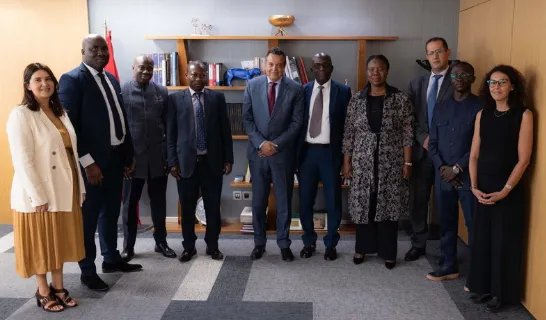
Finally, the Committee was informed of the holding, on November 27 in Rabat, of a high-level meeting between the officials of the MENAFATF and the Moroccan authorities, marking the official launch of the mutual assessment process of the national AML/CFT framework, scheduled to start in November 2026, as part of the third cycle of this fiscal year. This meeting also provided an opportunity to reaffirm Morocco’s political commitment to a coordinated mobilization of all national stakeholders, with a view to ensuring the smooth conduct and success of this assessment.
In this context, the Committee took note of the progress made in implementing the financial sector roadmap, developed as part of the national AML/CFT strategy led by the ANRF, in preparation for this assessment.